
HE300-4200-T — 3000 W Off-Grid Inverter, 24 V
One line: The HE300 line's entry off-grid unit — 3000 W on a 24 V battery, with a replaceable reverse-polarity fuse protecting the power stage and a no-load loss the specification sheet puts at under half that of a same-power high-frequency unit.
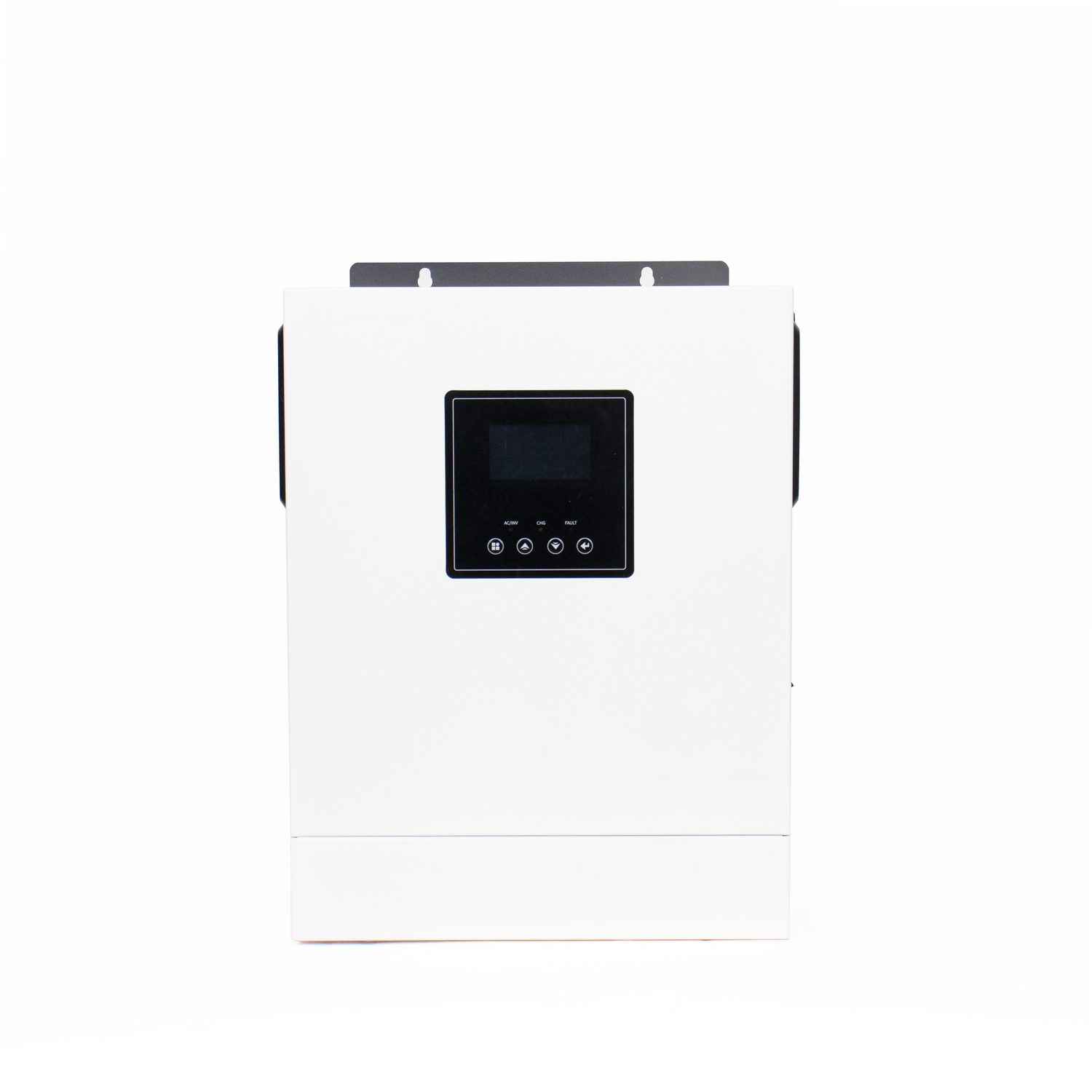
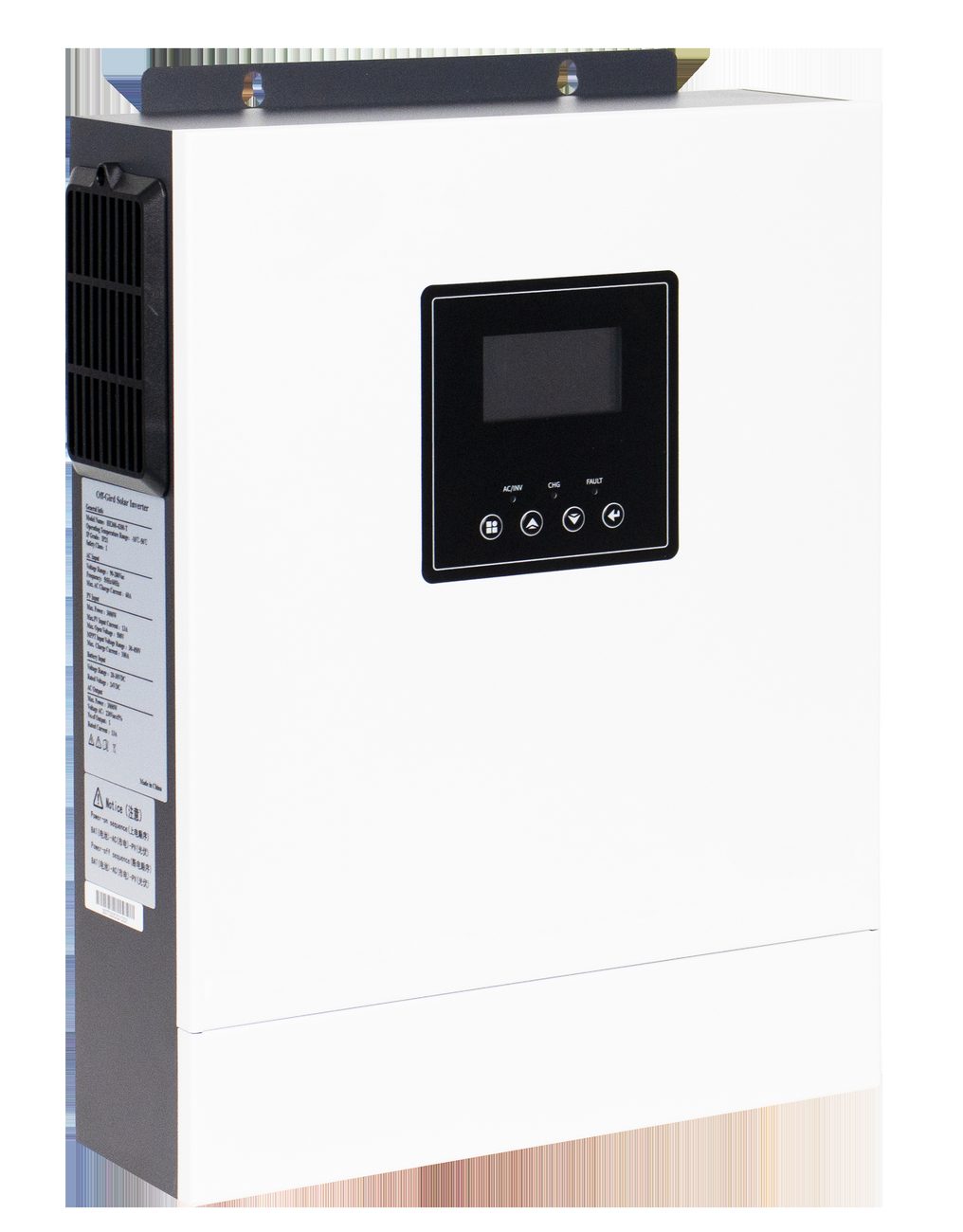
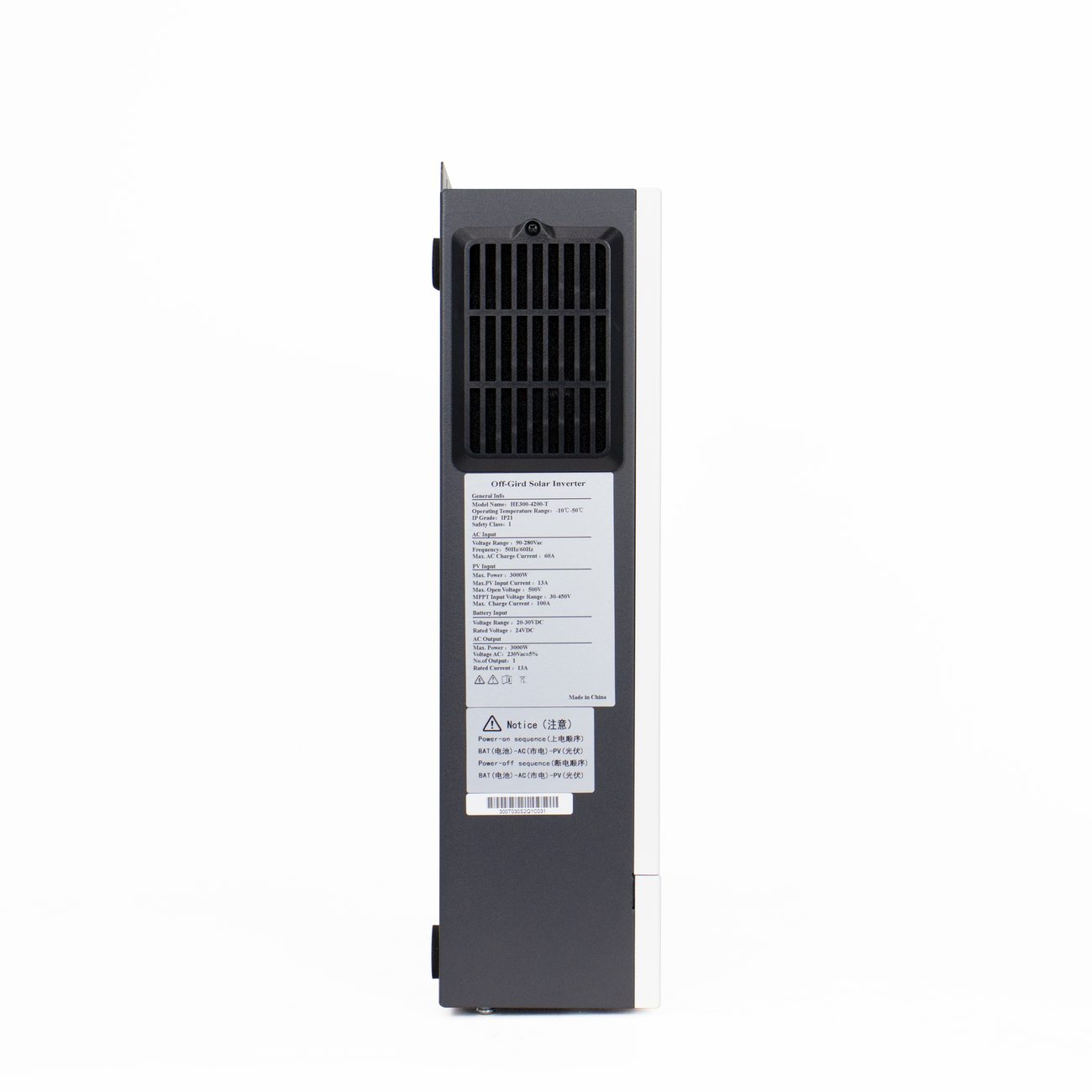
Specifications
| Category | Item | Value |
|---|---|---|
| Inverter output | Maximum output power | 3000 W |
| Maximum output voltage | 240 Vac ±5% (single phase) | |
| Maximum output current | 13.63 A | |
| Output frequency | 50/60 Hz | |
| Output waveform | Pure sine wave | |
| Output topology | L+N+PE | |
| Battery | Battery type | Lead-acid / lithium |
| Rated battery voltage | 24 Vdc | |
| Max combined PV charge current | 100 A | |
| Charging modes | Two-stage / three-stage / automatic | |
| Reverse-polarity protection | Replaceable fuse | |
| PV input | MPPT strings | 1 |
| Maximum input power | 3000 W | |
| Maximum open-circuit voltage | 500 Vdc | |
| Maximum short-circuit current | 13 A | |
| Working voltage range | 30–450 Vdc | |
| Grid / generator input | Input voltage range | 90–280 Vac ±3 V (APL) / 170–280 Vac ±3 V (UPS) |
| Rated input voltage | 230 Vac | |
| Input frequency | 50/60 Hz | |
| Maximum utility charge current | 60 A | |
| General | Dimensions | 402 × 310 × 105 mm |
| Packing dimensions | 467 × 390 × 188 mm | |
| Net weight | 6.5 kg | |
| Gross weight | 7.45 kg | |
| Protection rating | IP21 | |
| Operating temperature | −10 to 50 °C | |
| Cooling | Smart fan cooling | |
| Humidity | 20–95% |
The reverse-polarity fuse — what it protects
Battery wiring is where most field failures on an off-grid unit begin. Connect the bank the wrong way round and the current path runs backwards through the DC bus, the charge stage and the power devices — damage that is usually terminal for the board, and not a warranty conversation the buyer wins.
This model carries a replaceable battery reverse-polarity fuse in that path. Reversed wiring opens the fuse instead of letting the damage through. Two things it is not worth assuming:
- It is not a substitute for checking polarity before you connect. Fit the fuse, then still confirm positive and negative at the terminal.
- It is not a resettable breaker. It is a fuse — carry a spare, because the site that needs it is the site with no spares.
Low no-load loss — why it matters on this size
An off-grid inverter sits idle for most of the day. Whatever it draws while doing nothing is drawn from the battery every hour, and it comes off the top of your usable capacity before any load is connected.
The specification sheet for this model quotes a no-load loss below half that of a same-power high-frequency unit. That is the manufacturer's figure rather than a measured one we can hand over, so ask for the value at your battery voltage before you size the bank. The direction of the claim is the point: it suits small, always-on loads better than large intermittent ones.
APL and UPS input modes
The utility and generator input has two voltage windows, and the unit is set to one of them:
- APL mode — 90–280 Vac. Wider window, tolerant of a weak or unstable supply. Used where the grid or generator is poor and the load is not sensitive to transfer time.
- UPS mode — 170–280 Vac. Narrower window, faster transfer. Used where the load is sensitive and the supply is reasonably stable.
Setting the wrong mode for the supply condition causes nuisance transfers — the unit switching to battery when it did not need to. Details are in the installation guide.
Sizing context
A 3000 W output against a 3000 W PV input is a 1:1 ratio. That is deliberate on a battery-first unit: the array is sized to serve the load and charge the bank, not to carry the load on its own. Read the PV figure as a ceiling, not a target. If you want the array to run the load and refill the battery inside a short solar window, this is not the model for it and the larger HE300 units are.
What 3000 W carries comfortably:
- lights, a fridge, a television, fans and phone charging — typically 1–1.5 kW connected;
- power tools on a workshop circuit, watching the start-up surge;
- a small pump — pumps start at 2–3× rated power, so check the surge figure rather than the running figure;
- a shop counter, a clinic refrigerator or a small office.
At 24 V and 3000 W the battery current is around 125 A, which is manageable on 35–50 mm² cable over a short run. A 48 V model would halve that current if cable size or run length is the constraint — the worked numbers are in the sizing guide.
Connections, monitoring and accessories
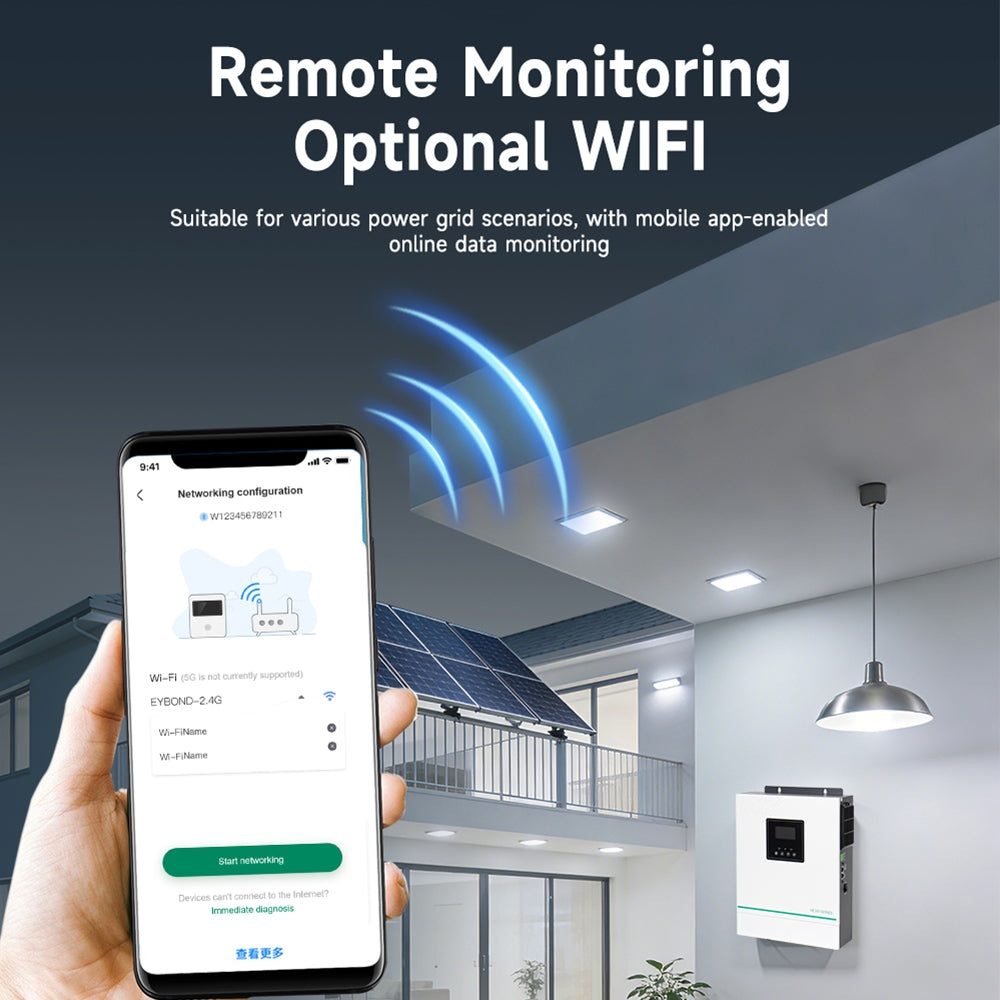
Terminal layout, system wiring, monitoring options and the accessories supplied with the unit.
Certification coverage
| Certification | Status |
|---|---|
| CE (LVD + EMC) — M.2025.206.C116069 | Not held for this model |
| CE (EMC) — CKEYS251201016 | Not held for this model |
| FCC SDoC — CKEYS251013025 | Not held for this model |
| RoHS 2.0 — CKEYS251013024 | Not held for this model |
| GB 4943.1-2022 — BDL260706S002 | Covered (series declaration) |
Be clear about this one. The only compliance document held for the HE300-4200-T is the GB 4943.1-2022 safety test report, and it is covered there by series declaration rather than as the main test article. GB 4943.1-2022 is a Chinese national safety standard — it is not a CE mark and it is not a European market approval. No CE, FCC or RoHS file lists this model. If your destination market requires one of those, tell us the model number and the market and we will state the position rather than imply coverage. Every certificate number and its covered model range is on the certifications page.
Related models
- Same power, wider PV input: HE200-4200-T — 3600 W output, 5000 W PV
- Smaller off-grid unit: HE200-2500-O — 1200 W, 12 V battery
- 48 V alternative with a larger array: HE300-7200-F — 6200 W, 8500 W PV
- Low-frequency build for high-surge loads: HE310-5000-F
- Off-grid inverter range