
Off-Grid Solar Inverters
One line: For sites with no utility connection: two dedicated off-grid models with published specifications, plus clear guidance on when to choose off-grid and when hybrid is the better fit.
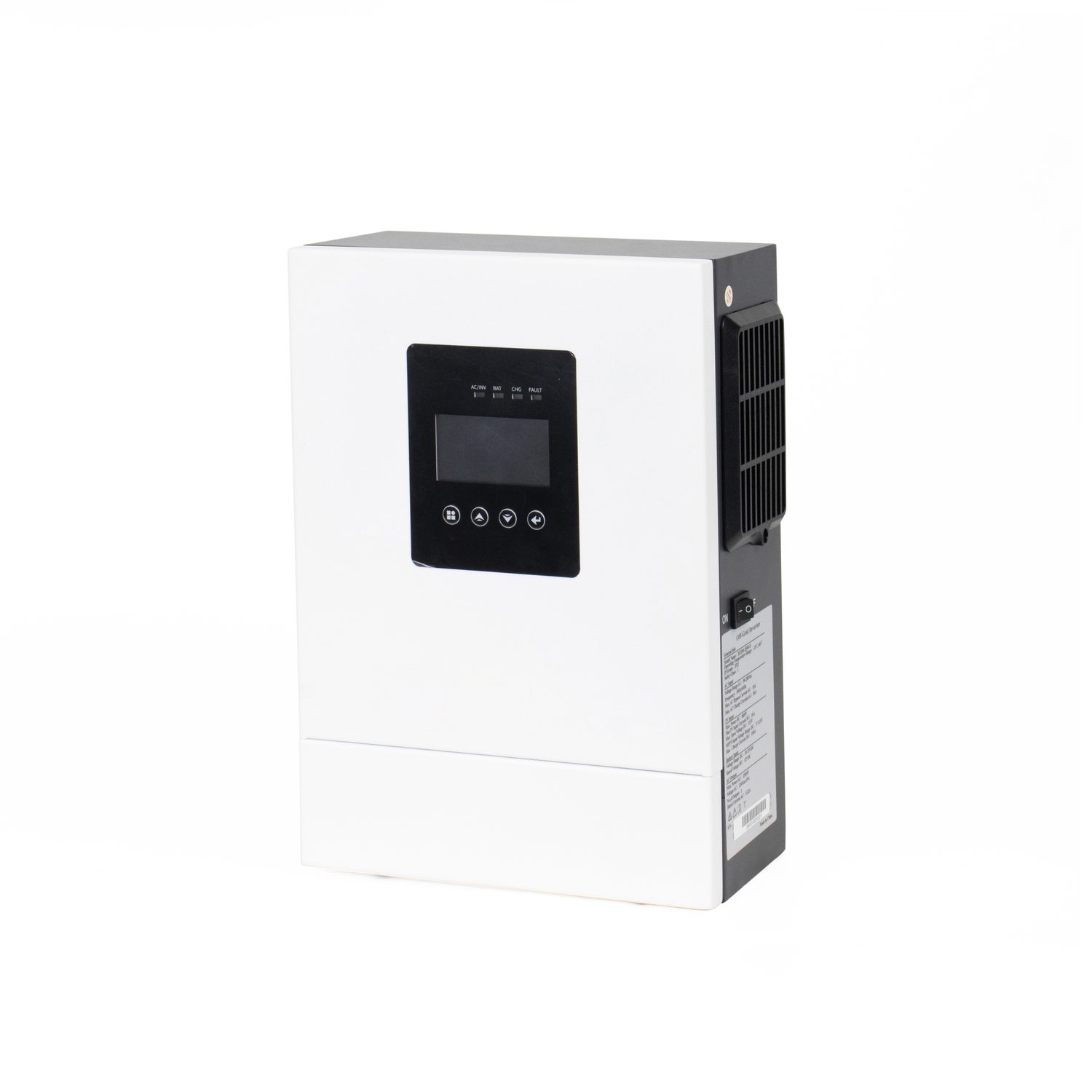
Off-grid models
| Model | Rated output | Battery voltage | Max PV input | Output topology | Net weight |
|---|---|---|---|---|---|
| HE200-2500-O | 1200 W | 12 V | 800 W | L+N+PE (single phase) | 3.85 kg |
| HE300-4200-T | 3000 W | 24 V | 3000 W | L+N+PE (single phase) | 6.5 kg |
Both run from a lead-acid or lithium battery bank with PV charging. Both output 230/240 Vac ±5% single-phase at 50/60 Hz, pure sine wave.
The two models in detail
HE200-2500-O — 1200 W, 12 V. The small-site unit. Built-in MPPT (no external controller needed), smart temperature-controlled cooling that stays quiet at low load, and a 12 V battery bank. Suits a cabin or a single-room load: lights, a television, phone charging and one efficient fridge. Full specification and sizing notes →
HE300-4200-T — 3000 W, 24 V. The larger of the two, and the one carrying a notable safety feature: a replaceable battery reverse-polarity fuse that opens instead of letting reversed wiring damage the power stage. It also quotes a no-load loss below half that of a same-power high-frequency unit, and an LCD for live monitoring. Full specification, sizing notes and the certification position →
Both are listed in full in the table above. Where they differ, it is battery voltage and PV ceiling — 12 V / 800 W against 24 V / 3000 W — not just output power.
Off-grid or hybrid — how to decide
| Question | If yes → |
|---|---|
| Is there truly no grid and no generator, now or later? | Off-grid model |
| Might a generator or grid be added later? | Hybrid model — it accepts the input without replacement |
| Is the load likely to grow beyond this unit? | Hybrid, ideally a parallel-capable model |
| Is this a fixed, small load with no growth? | Off-grid — simpler and cheaper |
| Is critical-load separation needed (drop non-essential loads on low battery)? | Hybrid — dual AC output models only |
The practical difference is flexibility. An off-grid unit serves a defined load well. A hybrid unit keeps options open. If you are unsure, describe the site and expected load and we will advise — see hybrid inverters for the alternative.
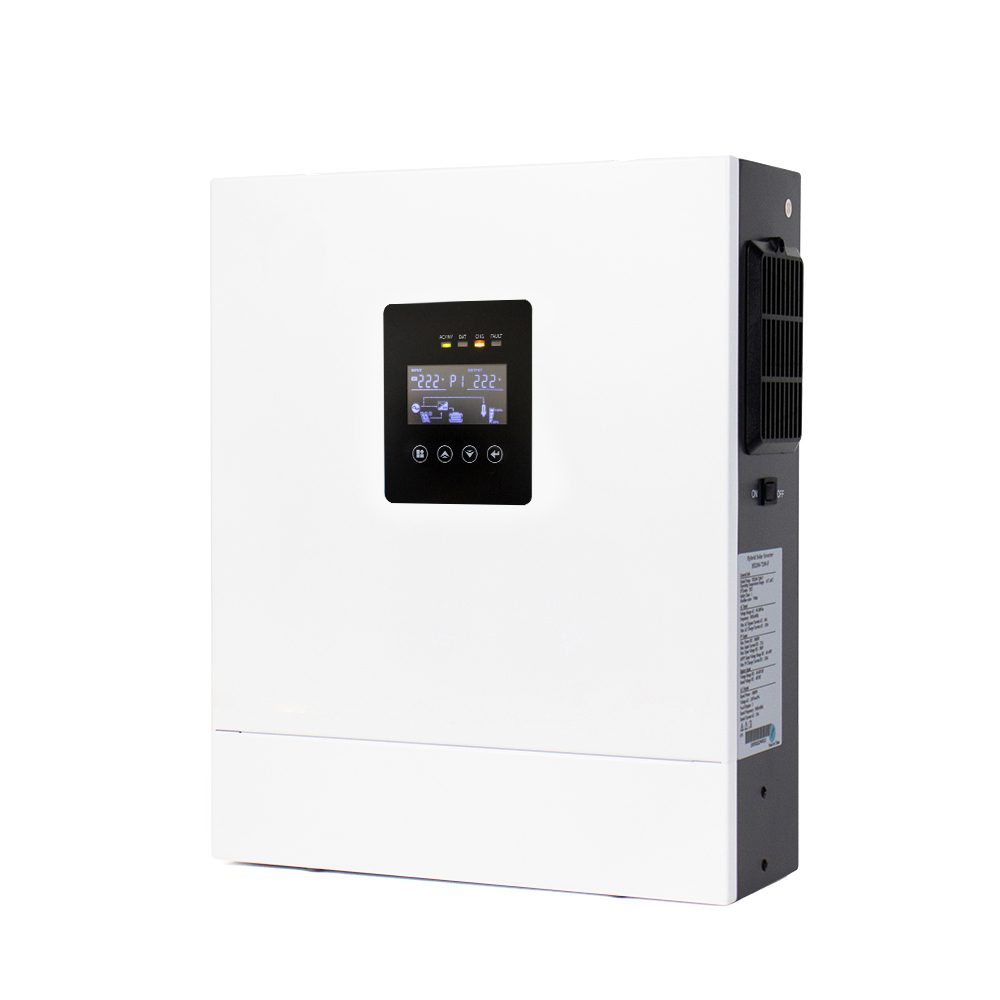
Planning an off-grid system
Three numbers drive the design:
- Connected load (W) — the total of everything that might run at once. Size the inverter above this, not below.
- Daily energy (kWh) — load × hours per day. This sizes the battery.
- PV array (W) — daily energy ÷ realistic peak-sun hours. This sizes the panel array.
Battery voltage follows the inverter: 12 V for the HE200-2500-O, 24 V for the HE300-4200-T. A 12 V system keeps battery cost and cable size low but limits practical power; 24 V and 48 V systems carry higher loads on smaller cables.
Worked examples for both models are in the sizing guide, and installation specifics — cable sizes, breaker ratings, connection sequence — are in the installation guide.
Related pages
- Hybrid inverters
- How to size a solar inverter
- Installation and wiring guide
- Certifications
- OEM / ODM — supplying these models under your own brand