
How to Size a Solar Inverter
One line: Sizing runs in one direction — load first, then inverter, then battery voltage, then PV. Getting that order wrong is what produces oversized inverters and undersized battery banks.
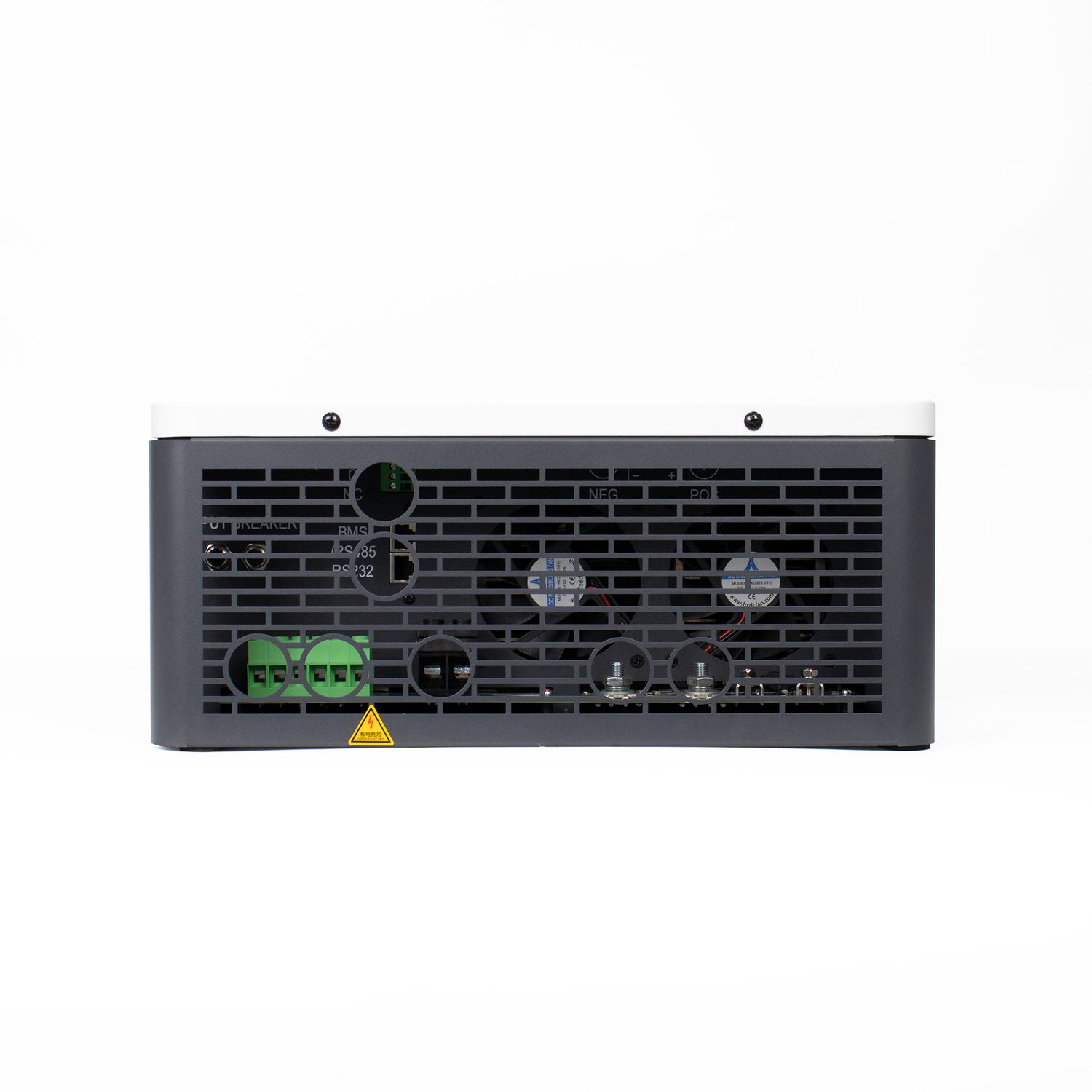
The four numbers you need
Before looking at any model, gather four figures:
- Connected load (W) — everything that could run at once.
- Surge load (W) — the starting current of the biggest motor or compressor.
- Daily energy (kWh) — load × hours per day.
- Autonomy (days or hours) — how long the system must run with no PV input.
Everything else follows from these.
Step 1 — List the loads
Write down every appliance with its running wattage and the hours per day it runs. A residential example:
| Load | Running power | Hours/day | Energy/day |
|---|---|---|---|
| LED lighting × 6 | 30 W each = 180 W | 5 h | 0.9 kWh |
| Refrigerator (inverter type) | 200 W | 8 h (compressor duty) | 1.6 kWh |
| Television | 100 W | 4 h | 0.4 kWh |
| Phone and laptop charging | 100 W | 3 h | 0.3 kWh |
| Water pump (0.75 kW) | 750 W | 1 h | 0.75 kWh |
| Ceiling fans × 2 | 75 W each = 150 W | 6 h | 0.9 kWh |
| Total | ≈ 1480 W connected | ≈ 4.85 kWh/day |
Two figures come out of this list:
- Connected load: 1480 W — this sizes the inverter.
- Daily energy: 4.85 kWh — this sizes the battery.
Step 2 — Size the inverter for load and surge
Choose an inverter whose rated output exceeds the connected load, then check surge on top.
Our example has 1480 W of connected load. The water pump is the surge risk: a 750 W pump can draw 2–3 times its rating for a second at start-up — up to 2250 W momentarily.
| Model | Rated output | Fits this load? |
|---|---|---|
| HE200-3000-O-I5 | 2000 W | Tight — 1480 W load but surge margin is thin |
| HE200-4200-T | 3600 W | Yes, with surge headroom |
| HE200-6500-T | 5500 W | Yes, generous margin for load growth |
| HE200-7200-F | 6200 W | Yes, and 48 V battery |
The 2000 W unit technically covers a 1480 W running load, but leaves almost nothing for surge. The 3600 W model is the smaller sensible choice; the 5500 W model leaves room for load growth without over-specifying.
Do not size to the total of everything that exists. Size to what runs at the same time. A welder and a pump that are never used together do not need to be added.
Solar inverter size chart — PV inverter size by load
The chart below maps a PV inverter size to the kind of load it usually carries. Use it to shortlist a model, then run Steps 3 to 5 to confirm battery voltage, battery capacity and array size.
| Inverter size (rated output) | Loads this size typically carries | Battery voltage | Models |
|---|---|---|---|
| 1.2 kW | Lighting, TV, phone charging, one small fridge | 12 V | HE200-2500-O |
| 2 kW | The above plus fans and small power tools | 12 V | HE200-3000-O-I5 |
| 3.6 kW | Small home: fridge, 0.75 kW pump, lights, fans | 24 V | HE200-4200-T |
| 5–5.5 kW | House with a 1 kW pump and one air-conditioner | 24 V or 48 V | HE310-5000-F (5 kW), HE200-6500-T (5.5 kW) |
| 6.2 kW | House plus a workshop circuit; 48 V preferred | 48 V | HE200-7200-F, HE300-7200-F |
| 11 kW | Large house or small commercial site | 48 V | HE200-12000-F, HE300-12000-F |
| 55–99 kW | Commercial sites, paralleled units | 48 V | HE200-7200-FP (58.5 kW), HE300-7200-FP-I5 (55.8 kW), HE300-12000-FP (99 kW) |
Two caveats before you use the chart:
- The load column is a starting point, not a rule. A pump, compressor or welder adds surge, and surge decides whether a size is adequate — check the surge figure in Step 2.
- Inverter sizing and battery sizing are two separate decisions. The chart gives the PV inverter size; it says nothing about how many kWh of battery you need. That comes from daily energy and autonomy in Step 4.
When your load falls between two rows, size up if it contains motors, and take the lower row if it is resistive only (lighting, heaters, electronics).
Step 3 — Choose battery voltage
Battery voltage is set by the inverter suffix — O = 12 V, T = 24 V, F = 48 V. It is not a free choice; it must match the inverter.
| Battery voltage | Practical power band | Cable size implications |
|---|---|---|
12 V (O) | Up to ~1.2 kW | High current, thick cable |
24 V (T) | ~2–5 kW | Moderate current |
48 V (F) | Above ~5 kW | Lower current, thinner cable |
The reason is Ohm's law. A 5000 W load at 12 V draws over 400 A; the same load at 48 V draws about 104 A. High current means thick, expensive cable and heat. Above roughly 5 kW, 48 V is the practical choice — which is why the HE200-12000-F and HE300-12000-F are both 48 V machines.
Matching battery voltage to the inverter is not optional. Connecting the wrong battery voltage can destroy the unit's capacitor bank — the manufacturer's manual states this as a hard warning.
Step 4 — Size the battery
Usable capacity (kWh) = daily energy (kWh) × autonomy (days) ÷ depth of dischargeOur example uses 4.85 kWh per day. For one day of autonomy at 80% depth of discharge:
4.85 × 1 ÷ 0.8 ≈ 6.1 kWhSo the battery bank needs roughly 6 kWh usable. Two 5.12 kWh packs in parallel (10.24 kWh gross) give comfortable headroom; a single 16 kWh pack suits two days.
Respect the charge-rate limit as well:
- Lead-acid: charge at no more than 0.2C. A 24 V 200 Ah bank → 200 × 0.2 = 50 A maximum.
- Lithium: charge at no more than 0.5C. A 48 V 200 Ah bank → 200 × 0.5 = 100 A maximum.
Set the inverter's charge-current parameter to respect this. Over-current shortens battery life sharply.
Step 5 — Size the PV array
Array size (W) = daily energy (kWh) ÷ peak-sun hoursAt 4.85 kWh per day with 4 peak-sun hours:
4.85 ÷ 4 ≈ 1.2 kWThen add for losses — wiring, temperature derating, inverter efficiency and non-ideal orientation typically cost 20–30%. A realistic target is 1.5–1.6 kW of array.
Check it against the inverter's PV limits:
| Constraint | HE200-7200-F | HE300-12000-F |
|---|---|---|
| Max PV input power | 9000 W | 2 × 7500 W |
| PV working voltage range | 60–450 Vdc | 90–450 Vdc |
| Max open-circuit voltage | 500 Vdc | 500 Vdc |
| Max short-circuit current | 27 A | 2 × 27 A |
Practical panel wiring, using 540–700 W panels with 45–55 V open-circuit voltage: string 4 to 8 panels in series, then parallel as needed for array size. Exceeding 500 V open-circuit risks immediate damage.
Worked example — small off-grid cabin
| Parameter | Value |
|---|---|
| Loads | 6 LED lights, phone charging, small fridge, TV |
| Connected load | ≈ 800 W |
| Daily energy | ≈ 2.6 kWh |
| Autonomy required | 1 day |
| Suggested model | HE200-2500-O — 1200 W, 12 V |
| Battery | 12 V 200–300 Ah LiFePO4 |
| PV array | ≈ 700–800 W (within the 800 W input limit) |
Everything fits within the model's limits with margin on the load and the PV input.
Worked example — home with critical-load separation
| Parameter | Value |
|---|---|
| Loads | Full house, with pumps and a workshop circuit |
| Connected load | ≈ 5600 W |
| Surge | 0.75 kW pump × 3 |
| Daily energy | ≈ 12 kWh |
| Autonomy required | 1 day |
| Suggested model | HE200-7200-F — 6200 W, 48 V, dual AC output |
| Battery | 48 V, ≥400 Ah — two 5.12 kWh packs minimum |
| PV array | ≈ 4–5 kWp, well within the 9000 W input |
The dual AC output is what makes this case fit the 7200-F: critical circuits go on the main output, the workshop on the secondary. When the battery runs low, the inverter drops the secondary output so the house keeps running. Sizing alone would not have selected a dual-output model — the requirement did.
Common sizing mistakes
- Sizing the inverter to the total nameplate of every appliance. Only simultaneous loads count.
- Ignoring surge. Motors and compressors start at 2–3× rated power.
- Undersizing the battery to save cost. The battery determines backup duration, not the inverter.
- Mixing battery voltages. A 24 V pack on a 48 V inverter damages the unit.
- Oversizing the PV array past the input limit. Surplus is clipped at best, and over-voltage past 500 V damages the unit.
- Assuming the model number is the wattage. A
7200model is a 6200 W machine — see the decoder.
Next step
Send us the load list, autonomy requirement and battery chemistry, and we will come back with a model recommendation and the calculation behind it.
Request a sizing review · Hybrid inverter range · Model number decoder · Installation guide