
Hybrid vs Off-Grid Solar Inverter
One line: Off-grid means no grid input at all. Hybrid means off-grid, grid-connected and mixed modes in one unit. If a grid or generator might ever arrive, that single difference decides the purchase.
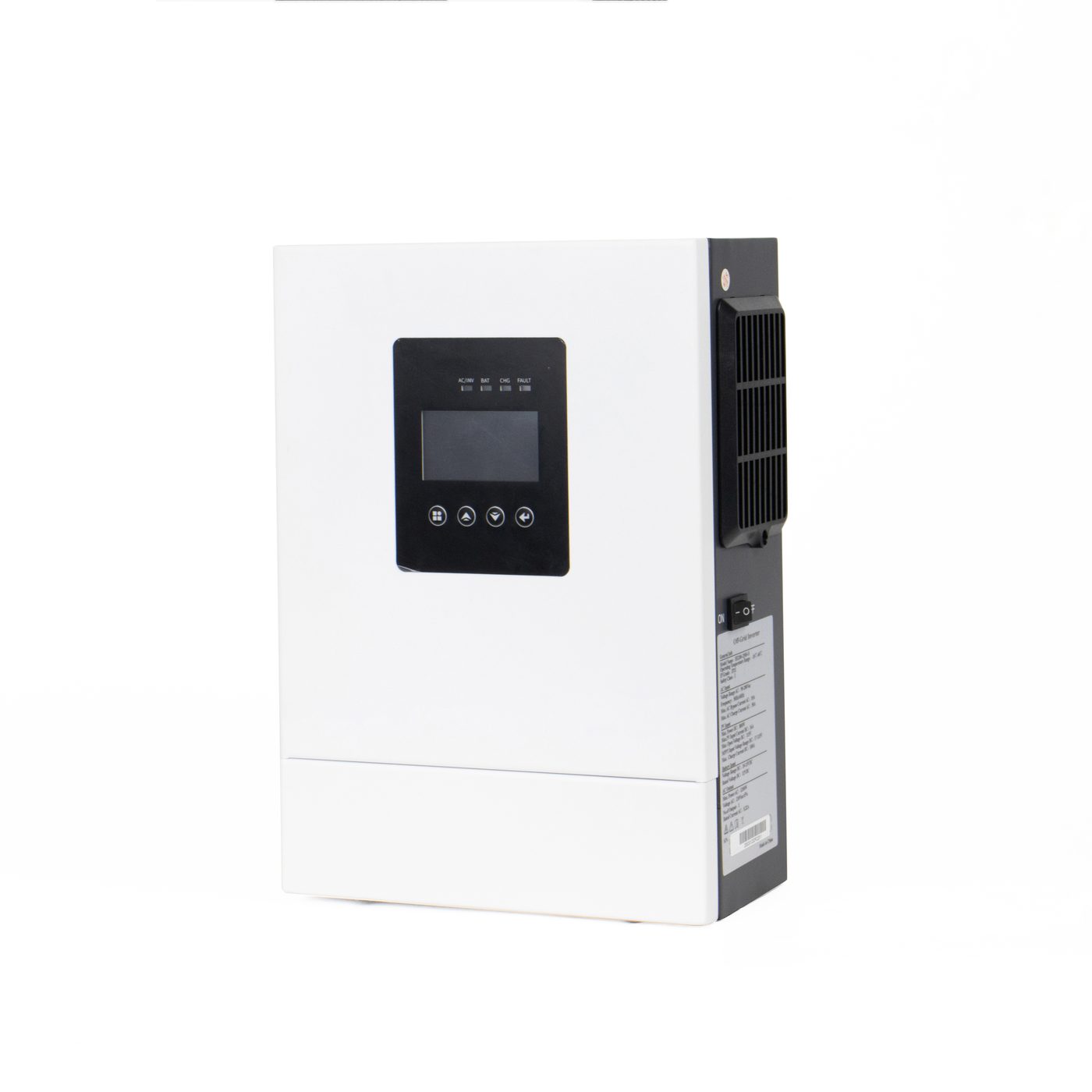
The core difference
| Off-grid inverter | Hybrid inverter | |
|---|---|---|
| Grid / generator input | None | Yes — 90–280 Vac |
| Operating modes | Off-grid only | Off-grid, grid-connected, mixed |
| Anti-reverse-flow | N/A | Yes, in mixed mode |
| Battery-free operation | No | Yes |
| Dual AC output by priority | No | Yes (6500 W class and above) |
| Parallel expansion | No (models listed here) | Yes — up to 9 units (FP models) |
| Monitoring app | Basic | Wi-Fi app and cloud platform |
| Typical cost | Lower | Higher |
Everything else — pure sine output, MPPT charging, protection features — is common to both.
Where each type fits
Choose off-grid when the site has no utility connection and no realistic prospect of one: a remote cabin, an agricultural site far from the grid, a telecom repeater, a seasonal installation. The inverter takes PV and battery, feeds the load, and that is the whole system. Nothing about grid rates, feed-in rules or transfer time applies.
Choose hybrid when any of these is true:
- A grid connection exists, or a generator is used, or either might be added.
- The site needs uninterrupted supply — hybrid units switch between grid and battery in about 20 ms, fast enough that computers and sensitive equipment ride through.
- Critical and non-critical loads should be separated, so non-essential circuits drop out first when the battery runs low.
- The load may grow — parallel units expand to 58.5 kW (HE200-7200-FP) or 99 kW (HE300-12000-FP) across 9 units.
- The buyer wants to start without a battery and add storage later, using battery-free operation.
Two features unique to the hybrid models
Battery-free operation. A hybrid unit runs on PV and grid with no battery connected. The buyer avoids the battery cost up front and adds it later without touching the inverter. Off-grid units require a battery — they have no other source.
Dual AC output by priority. From the HE200-6500-T upward, hybrid models use an L1+N1+L2+N2+PE topology: a main output and a secondary output. Critical loads go on the main, non-critical on the secondary, and the unit drops the secondary output when battery charge falls low, extending runtime on the critical circuits. No off-grid model in this range offers that.
What does not change
Both types share the fundamentals:
- Pure sine wave output — motors, pumps and compressors start without the hum and heating caused by modified-sine output.
- MPPT charging — 99.5% peak PV charge efficiency on the HE200 line, 98% on HE300.
- Lead-acid or lithium batteries — both chemistries supported, with CAN/RS485 BMS communication on the hybrid models.
- Protection — over-voltage, under-voltage, overload, short circuit, over-temperature, reverse polarity and surge protection.
Cost, honestly
An off-grid inverter costs less than a hybrid unit of the same output because it lacks the grid input stage, the transfer switch and the mixed-mode logic. But cost of purchase is not cost of ownership:
- If a generator is later added to an off-grid site, the off-grid inverter cannot accept it — the unit is replaced, not extended.
- If a grid connection arrives, the same applies.
- If critical loads later need separation, an off-grid unit cannot do it.
The cheaper unit becomes the expensive one when a requirement changes. Where any doubt exists about the future power supply, the hybrid unit is usually the lower-risk choice even at higher initial cost.
Decision table
| Your situation | Recommendation |
|---|---|
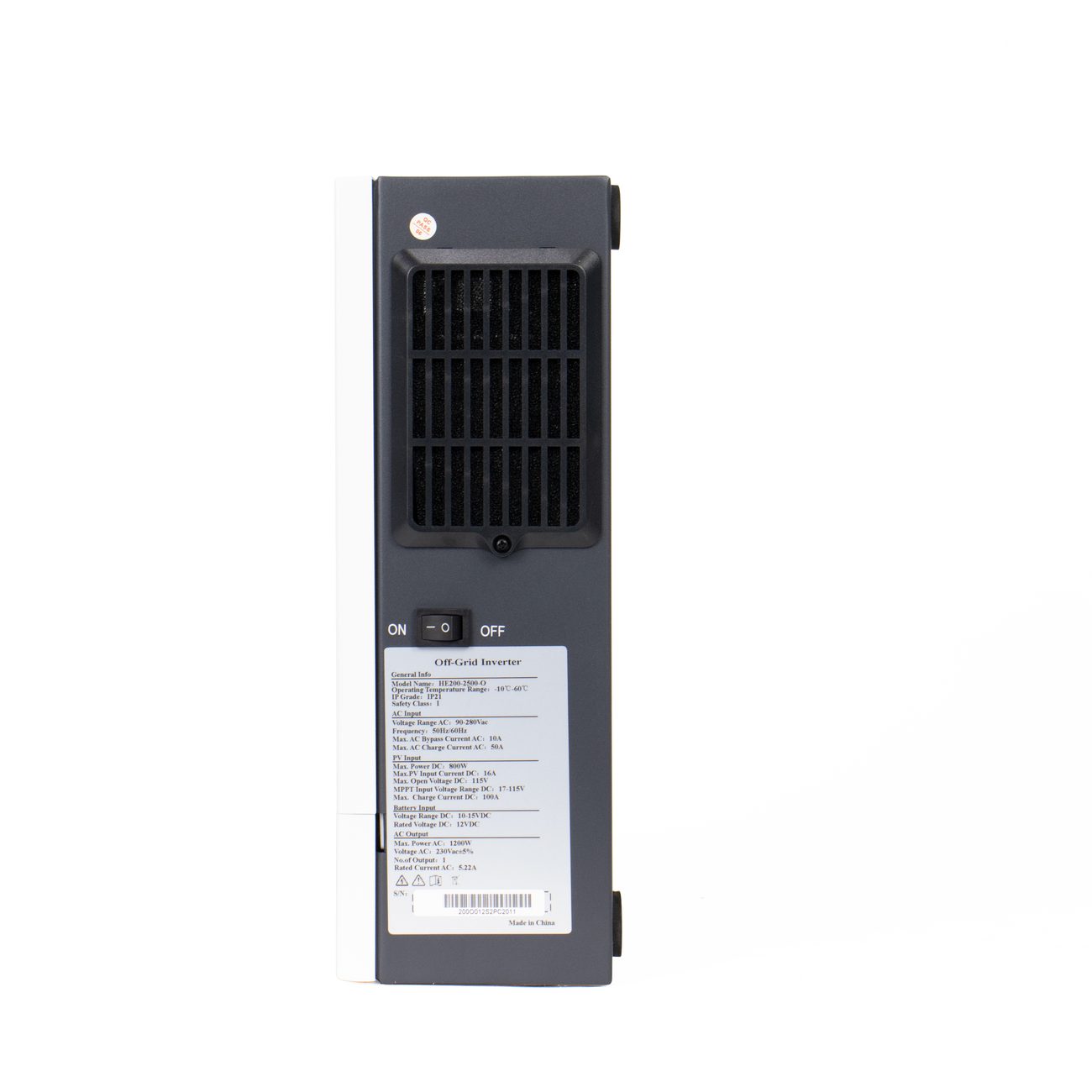
| No grid, no generator, never will be | Off-grid — HE200-2500-O (1200 W / 12 V) or HE300-4200-T (3000 W / 24 V) |
| No grid now, generator possible later | Hybrid — accepts generator input without replacement |
| Grid connection exists | Hybrid |
| Need battery-free operation now, battery later | Hybrid |
| Need critical-load separation on low battery | Hybrid, 6500 W class or above (dual AC output) |
| Load will grow beyond one unit | Hybrid FP model — parallel up to 9 units |
| Fixed small load, cost-sensitive | Off-grid |
Transfer time in practice
Transfer time is the gap when the unit switches between grid and battery. A laptop power supply rides through a gap of tens of milliseconds without noticing. A desktop PC or a control unit may reset if the gap is longer. The hybrid models here switch in about 20 ms, which is within UPS-class behaviour for typical office and residential equipment.
If you are protecting equipment where any interruption causes a problem, say so when specifying — the requirement changes the model class, and it is cheaper to specify correctly than to retrofit.
Summary
- Off-grid: no grid input, simplest system, lowest cost, no expansion.
- Hybrid: grid input, three modes, battery-free capable, dual AC output, parallel expansion — and a 20 ms transfer time for standby duty.
If the site will never see a grid or a generator, off-grid is the honest recommendation. If anything about the power supply might change, hybrid keeps the options open.