
LiFePO4 vs Lead-Acid for Solar Storage: Total Cost of Ownership
One line: For a solar system that cycles every day, LiFePO4 wins the ten-year cost comparison almost everywhere. Not because the battery is cheaper to buy, but because a lead-acid buyer pays for the same storage two to four more times before the LiFePO4 bank needs its first replacement.
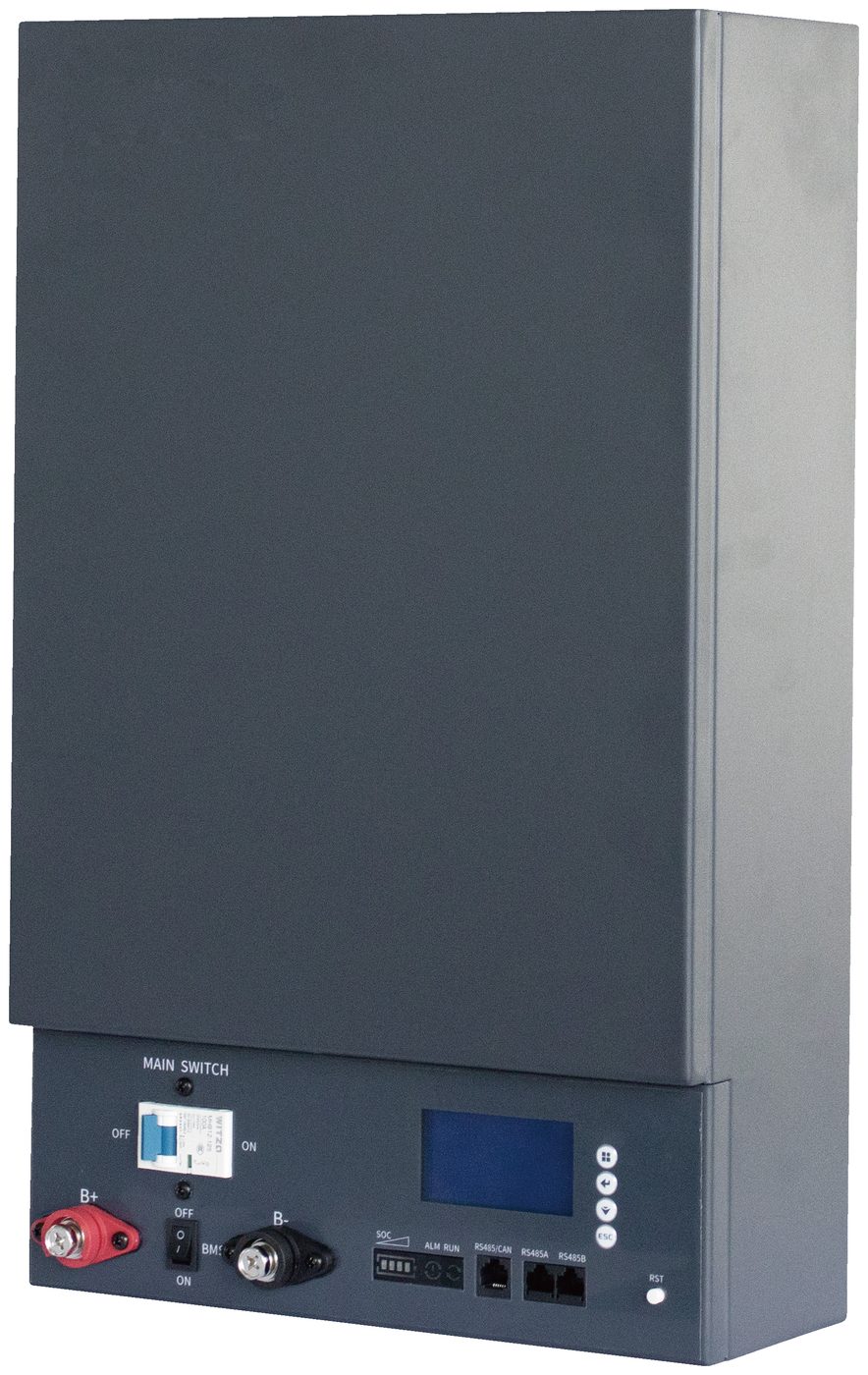
Lithium iron phosphate now accounts for close to 90% of global battery storage deployment (source: IEA, 2025). The shift is not fashion: it is arithmetic. A storage bank that cycles daily is bought with cycles, not with the sticker price, and on a cost-per-cycle basis LiFePO4 has crossed below lead-acid in most markets. This article walks through the comparison the way a buyer should actually run it: ten years of service, real ratings, and every cost the invoice does not show.
Grenkago supplies LiFePO4 battery packs alongside the hybrid inverters they pair with. We are a supplier and exporter, not a manufacturer, and we will say plainly where the comparison has nuance, including the two cases where lead-acid still makes sense.
This article compares two battery chemistries as technologies, using published ratings and recognised standards. It is not a comparison between any two companies' products, and no manufacturer or brand is assessed or ranked here. The brand names that appear below are part of a battery protocol compatibility list; each remains the trademark of its respective owner, and no endorsement or comparative claim is intended or made.
Why this comparison matters now
The global storage market has already voted: with roughly 90% of new deployments using LFP chemistry (source: IEA, 2025), the question is no longer whether lithium works, but whether the switch pays off for a specific duty cycle. In African markets the change is visible at the distributor level, where lead-acid stock is shifting from default choice to budget option. A household or small business that cycles a bank daily is the buyer for whom the calculation has tipped furthest, and also the buyer who can least afford to get it wrong twice.
Cost factor 1 — Cycle life decides how many banks you buy
This is the whole comparison in one row of a datasheet:
| Chemistry | Typical cycle rating | Daily-cycle service life | Banks needed for 10 years |
|---|---|---|---|
| LiFePO4 (our packs) | ≥6000 cycles at 25 °C, 0.5C, 80% depth of discharge, to 80% capacity retention (manufacturer datasheet) | 10 years and more | 1 |
| Deep-cycle lead-acid | roughly 300–1200 cycles depending on type, depth of discharge and maintenance (typical manufacturer datasheet ranges) | 1–3 years | 2–4 |
The LiFePO4 figure is a rating we hold test documentation for at the cell level: A-grade cells pass overcharge, over-discharge, external short-circuit, crush and drop testing to GB/T 36276-2018, the Chinese national standard for lithium batteries in stationary storage. The lead-acid range is honest, too: a well-treated flooded or AGM bank in a cool room can reach the top of that range; a bank cycled hard in a hot compound usually does not.
One bank versus three is the sentence to remember. Everything else below adds cost to the lead-acid column, not the other way round.
Cost factor 2 — Usable capacity: you buy more kWh than you get
Lead-acid ratings assume discharge to 50% depth; going deeper every day plateaus out the cycle count. LiFePO4 is rated at 80% depth of discharge in our datasheets. So a "10 kWh" lead-acid bank delivers about 5 usable kWh, while a 10 kWh LiFePO4 bank delivers about 8. Per usable kWh, the sticker price gap closes before maintenance even enters the account.
Cost factor 3 — Maintenance is a real wage
Flooded lead-acid needs watering on a schedule, terminal cleaning, and a ventilated battery room because of hydrogen gassing. In practice that is someone's recurring time, plus the risk that the schedule slips, which is exactly how lead-acid banks die early. A LiFePO4 pack carries an internal BMS that balances cells and protects against overcharge, over-discharge and over-temperature. Maintenance in normal service: none.
Cost factor 4 — Charge behaviour decides the daytime economics
A lead-acid bank accepts high charge current only near empty, then tapers, so a big solar array cannot refill it quickly in the hours around noon. Our LiFePO4 packs accept a high charge current, up to 100 A on the 5.12 kWh unit and 200 A on the 16 kWh unit, so a bank that ran the house overnight can be substantially refilled by mid-morning. The same array produces more useful energy per day into lithium. Nobody bills this as a line item, and it is one of the largest hidden costs of lead-acid in solar duty.
Cost factor 5 — Temperature and storage behaviour
Lead-acid loses capacity in the cold and ages faster in heat, and the markets where solar storage is growing fastest are hot. LiFePO4 holds its rated behaviour across a −20 to 55 °C discharge window in our packs, and self-discharge is under 3% per month at 25 °C, so a bank charged before a trip or a seasonal property hold keeps its state. Cell decomposition temperature above 500 °C is also why LiFePO4 became the chemistry of choice for wall-mounted batteries inside living spaces.
Cost factor 6 — What you cannot see on the invoice
Two honest notes, one per chemistry. For lead-acid: end-of-life disposal is increasingly regulated, and a 200 kg bank is a handling project. For LiFePO4: the up-front price per kWh is higher, and no UN38.3 test report is held at present. UN38.3 is required for lithium battery transport by air and sea, so international shipment of these packs is currently restricted. We confirm the position at quotation rather than assume it.
The ten-year table
For a home cycling 5 kWh daily, counted in bank purchases and service events over ten years:
| LiFePO4 bank | Lead-acid bank | |
|---|---|---|
| Bank purchases in 10 years | 1 | 2–4 |
| Usable kWh per day (10 kWh nominal) | ~8 | ~5 |
| Watering / terminal service | none | scheduled, recurring |
| Charge rate from solar array | up to 100 A / 200 A max, fast midday recovery | tapers near full, array idles |
| Capacity fade behaviour | rated to 80% retention at end of rating | progressive, accelerates with heat and depth |
| Disposal events | 1, at end of a decade | 2–4 heavy-bank disposals |
Read the table as a shape, not a quote: the exact money depends on local prices, but the number of bank purchases, the usable-kWh gap and the maintenance load are properties of the chemistry, and they do not move with currency.
When lead-acid still makes sense
Two cases, and we will say so when a buyer is in them. First, a system that cycles occasionally (a weekend property, or a backup that rarely engages) never accumulates enough cycles for chemistry economics to matter, and the lower up-front price is real money back. Second, a buyer with an existing, recently purchased lead-acid bank should run it to a sensible end of life rather than replace it mid-life; a mixed-chemistry transition on one bus is not recommended, because the charge profile that suits one bank mistreats the other. Plan the change as a whole-bank replacement and confirm the inverter's BMS protocol support first.
What to check before you order lithium
- Cycle rating in writing: at what temperature, charge rate, depth of discharge, and to what retention? Our packs: ≥6000 cycles at 25 °C, 0.5C, 80% DoD, to 80% capacity.
- BMS protocol against your inverter: our packs speak RS485/CAN with protocols used by Growatt, Pylontech, Deye, SRNE, Voltronic and Sofar units, and we confirm the pairing against your model before order. If communication fails, manual voltage settings are the documented fallback (see the installation guide).
- Cell certification: ask which standard the cells were tested to. Ours pass GB/T 36276-2018 stationary-storage testing.
- Transport position: no UN38.3 test report is held at present, and UN38.3 is required for air and sea transport of lithium batteries. Confirm the position with us before planning an international shipment.
How to get a sizing quotation
Send the daily kWh you need to cycle, your inverter model (or let us propose the pairing from the hybrid inverter range), and your floor or wall space. We return a battery and inverter configuration with the communication pairing confirmed in writing. Write to hello@grenkago.com or use the contact page.
Frequently Asked Questions
Is LiFePO4 cheaper than lead-acid over ten years?
In a daily-cycle solar application, yes for most buyers. One LiFePO4 bank covers ten-plus years of daily cycling at its ≥6000-cycle rating; lead-acid typically needs two to four replacement banks plus scheduled maintenance in the same period.
Why did LiFePO4 take over the storage market?
Cost per cycle fell below lead-acid as cell prices dropped, and the chemistry is thermally stable, with cell decomposition above 500 °C. LFP now accounts for close to 90% of global battery storage deployment (source: IEA, 2025).
Can I mix lithium and lead-acid on the same system?
Not on one bus. The charge profile that suits one chemistry mistreats the other. Move to lithium as a whole-bank replacement, with the inverter's BMS protocol support confirmed first. Grenkago checks the pairing against your inverter model before you order.
What maintenance does a LiFePO4 battery need?
None in normal service. The internal BMS balances cells and protects against overcharge, over-discharge and over-temperature. Flooded lead-acid needs watering, terminal cleaning and ventilation on a recurring schedule.
How long do your packs actually last?
Rated ≥6000 cycles at 25 °C, 0.5C, 80% depth of discharge, to 80% capacity retention, which with daily cycling is a service life beyond ten years. Self-discharge stays under 3% per month at 25 °C, and the cells pass GB/T 36276-2018 stationary-storage testing.
Conclusion
Run the comparison the way the battery will actually be used: daily cycles, ten years, heat included. LiFePO4 buys one bank and forgets it; lead-acid buys the same storage two to four times and asks for maintenance in between, while delivering fewer of the kWh you paid for every single day. Grenkago supplies 5.12 kWh and 16 kWh 51.2 V LiFePO4 packs with BMS communication across the major inverter protocols. See the battery range, and ask us to confirm the pairing with your inverter before you order.