
LiFePO4 Solar Battery Storage
One line: Two LiFePO4 battery pack sizes — 5.12 kWh and 16 kWh at 51.2 V — with BMS communication that supports a wide range of third-party hybrid inverters.
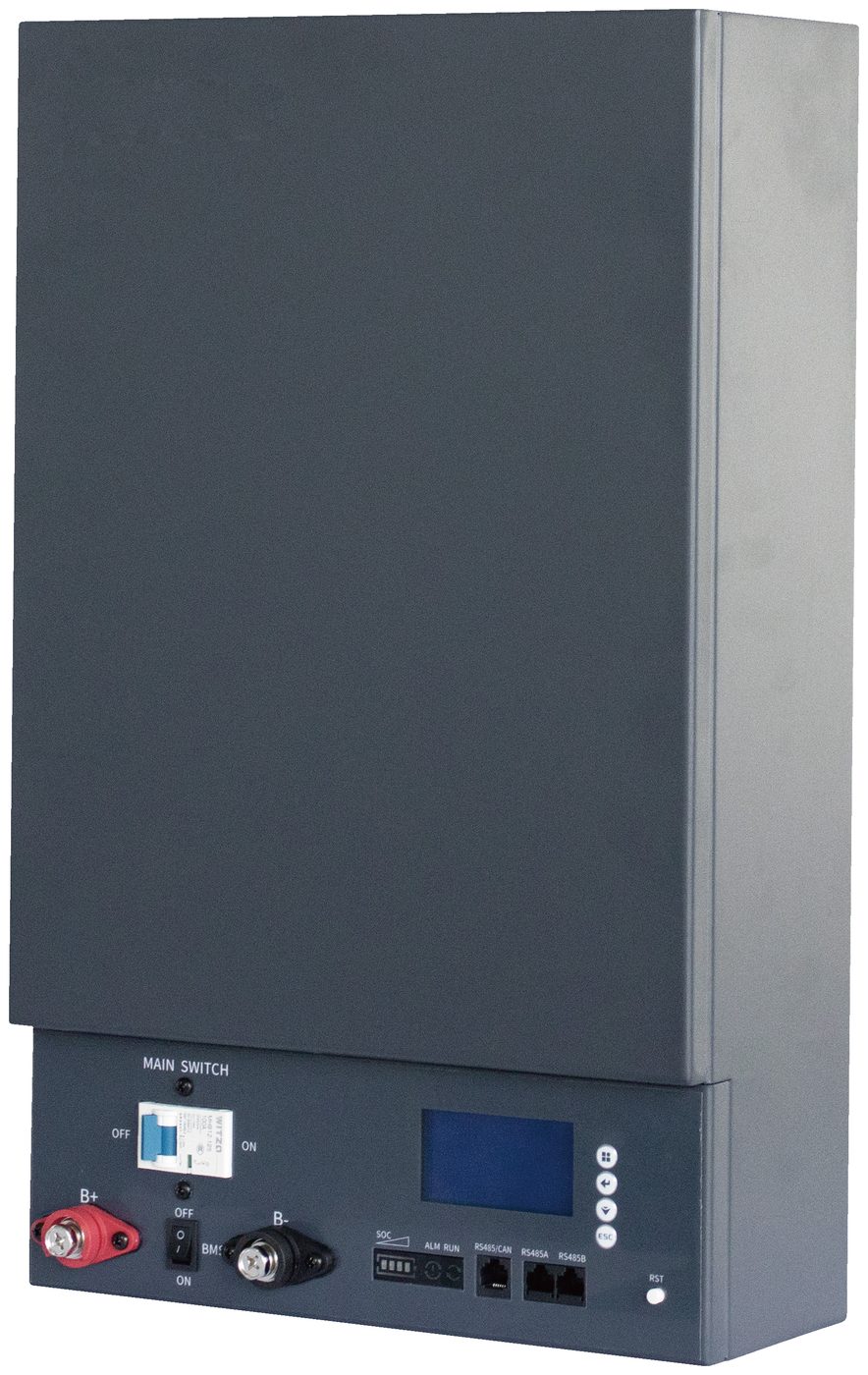
Battery packs
| H4B-N5-48V | H3B-W16-48V | |
|---|---|---|
| Nominal voltage | 51.2 V | 51.2 V |
| Nominal capacity | 100 Ah | 314 Ah |
| Total energy | 5.12 kWh | 16 kWh |
| Working voltage | 44–58.4 V | 44–58.4 V |
| Standard charge/discharge | 0.2C | 0.5C |
| Max charge/discharge current | 100 A | 200 A |
| Communication | RS485 / CAN | RS485 / CAN |
| Parallel communication | Dual RS485 | Dual RS485 |
| Cycle life | ≥6000 | ≥6000 |
| Charge temperature | 0–55 °C | 0–55 °C |
| Discharge temperature | −20–55 °C | −20–55 °C |
| Dimensions | 325 × 535 × 180 mm | 453 × 321 × 772 mm |
| Net weight | 42.6 kg | 120 kg |
Why LiFePO4
Lithium iron phosphate is the chemistry used across this range, and the reasons are specific rather than marketing language:
- Thermal stability — decomposition temperature is above 500 °C, so the cells do not readily combust at high temperature.
- Cell construction — square aluminium-shell cells that pass overcharge, over-discharge, external short-circuit, crush and drop testing to GB/T 36276-2018.
- Cycle life — A-grade cells rated at ≥6000 cycles at 25 °C, 0.5C, 80% depth of discharge, to 80% capacity retention. In normal daily-cycling use this is a 10-year-plus service life.
- Low self-discharge — ≤3% per month at 25 °C, so a charged pack holds its state for extended storage.
BMS and inverter compatibility
Each pack carries an internal BMS that monitors cell voltage and temperature and protects against overcharge, over-discharge and over-temperature. The BMS also raises usable capacity by keeping cells balanced and preventing premature shutdown.
Communication is over RS485 or CAN, with support for protocols including Growatt, Pylontech, Deye, SRNE, Voltronic, Sofar and others. When the BMS talks to a hybrid inverter, the inverter follows the battery's charge and discharge parameters automatically. Where protocol matching fails, the inverter can instead be configured with manual charge/discharge voltages — the parameter lists are in the installation guide.
Check compatibility before ordering. Protocol support varies by inverter model and firmware. Give us your inverter model and we will confirm whether direct communication is supported or whether manual voltage settings are needed.
The H4B-N5-48V in detail
A 5.12 kWh pack suited to a single hybrid inverter in a home system.
- Factory-supplied wall-mount bracket — wall installation needs no separate mounting kit.
- 100 Ah, 51.2 V, 100 A max charge/discharge, 0.2C standard rate.
- Working temperature 15–35 °C for rated operation; discharge down to −20 °C.
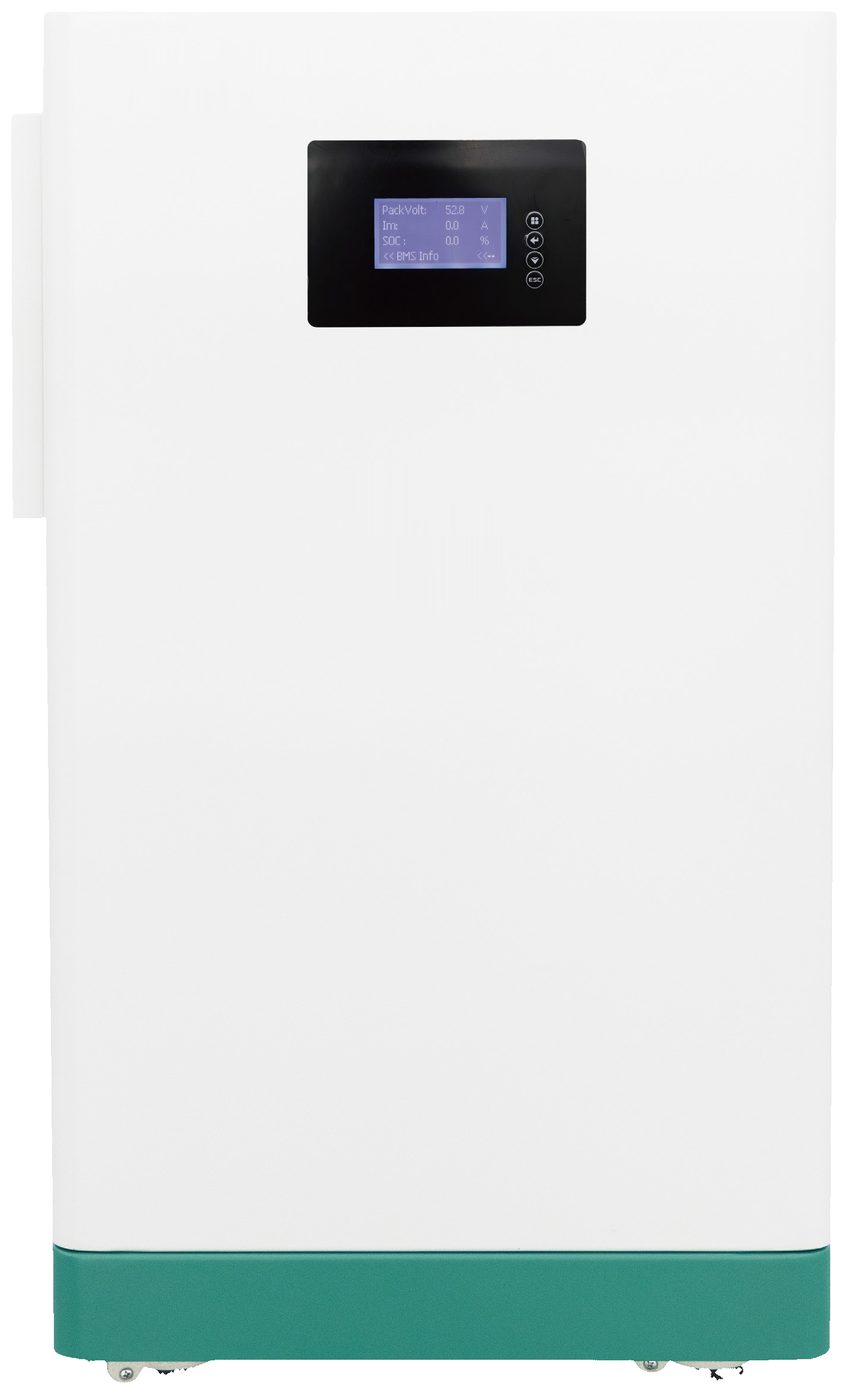
The H3B-W16-48V in detail
A 16 kWh pack for systems needing longer autonomy or higher sustained current.
- 314 Ah, 51.2 V, 200 A max charge/discharge, 0.5C standard rate.
- Dual RS485 for pack-to-pack parallel communication.
- 120 kg net — plan for two-person handling and a suitable mounting surface.
Battery sizing basics
Battery capacity follows from daily energy use, not from the inverter rating. The calculation:
Usable capacity (kWh) = daily consumption (kWh) × days of autonomy ÷ depth of dischargeFor a home using 6 kWh per day with one day of autonomy at 80% depth of discharge, that is 6 × 1 ÷ 0.8 = 7.5 kWh — so either two H4B-N5-48V packs in parallel or one H3B-W16-48V with headroom.
Two rules that catch people out:
- Match battery voltage to the inverter. A 48 V inverter needs a 48 V pack. Connecting the wrong battery voltage can destroy the inverter's capacitor bank — this is stated plainly in the manufacturer's manual.
- Charge current limits. Lead-acid batteries should not be charged above 0.2C; lithium above 0.5C. The charge-current parameter must be set to respect this, or battery life shortens sharply.
More on voltage matching is in the sizing guide; charge-current settings are in the installation guide.
Certification and shipping note
The battery packs currently hold no certification files, and no UN38.3 test report is held. UN38.3 is mandatory for shipping lithium cells by air or sea, so transport for these units is currently restricted. We will confirm the position at quotation rather than assume.
Related pages
- All-in-one energy storage
- Hybrid inverters
- Certifications
- OEM / ODM — supplying these models under your own brand