
How to Choose a Hybrid Inverter for Off-Grid Homes in Nigeria
One line: For an off-grid home in Nigeria, the decision is made on five checks: rated output (not the model number), 48 V battery match, PV input, a load-priority output, and a parallel path for later growth. Get those five right and the inverter will outlive two diesel-price cycles.
Nigeria's grid reached 61.2% of the population in recent industry data, leaving roughly 80 million people to run their homes on generators, inverters or nothing at all (source: IndexBox, 2026). With diesel at USD 0.80–1.20 per litre in 2026, a household that runs a generator for six hours a day pays for that fuel every single month, and the price moves with markets the household cannot control (source: IndexBox, 2026). A hybrid inverter with a battery bank converts that running cost into a one-time equipment decision.
Grenkago is a supplier and exporter of solar inverters and LiFePO4 energy-storage systems based in China. We are not a manufacturer, and we make no claim about production facilities. We hold the export documentation and the certificates covering the model ranges listed on them, and our job in this article is to tell you what to check, not what to overlook.
Why this question matters in 2026
Africa's residential storage market is forecast to grow from USD 1.2–1.6 billion in 2026 to USD 5.5–7.5 billion by 2035, a compound annual growth rate of 16–20% (source: Boin Group industry round-up, 2026). South Africa, Nigeria and Kenya together account for 55–65% of that regional demand, and Nigerian buyers show a clear preference for 5–10 kWh systems supplied by Chinese brands (source: IndexBox, 2026).
That combination (weak grid, expensive diesel, mature Chinese supply chain) is exactly why the hybrid inverter category has become the default choice for Nigerian homes. The hybrid unit connects PV, grid (where it appears) and battery in one box and switches between them by configuration, so the home keeps running through outages without anyone touching a changeover switch.
Check 1 — Rated output, not the model number
The single most common mistake in this market: buying by the number printed in the model name. A "7200" hybrid is a 6200 W machine; a "12000" delivers 12000 W in the HE200 line but 11000 W in the HE300 line. Every figure below comes from the manufacturer's specification sheets.
What matters for a home:
- Continuous rated output must cover the loads that run at the same time. A fridge (200 W), lighting (100 W), fans (150 W), TV (100 W) and a 1 HP water pump (750 W surge to about 2200 W) together sit comfortably under a 6200 W unit.
- Surge headroom for motors and compressors, which draw 2–3 times rated power for a second at start-up. Pure sine wave output matters here: modified-sine units make motors buzz and run hot.
- Dual AC output changes the maths on outages. From the 5500 W class upward, our hybrid models use a main + secondary output topology. Critical loads stay on the main output; when the battery runs low, the unit drops the secondary output automatically instead of shutting the house down.
Check 2 — Battery voltage must match the storage plan
The suffix in the model number is the battery voltage: O = 12 V, T = 24 V, F = 48 V. A 6500-T and a 7200-F are different machines wired for different battery banks, even though the numbers look close.
For Nigerian homes the practical answer is 48 V above roughly 5 kW of load, for three reasons:
- The 5–10 kWh wall-mounted lithium packs this market prefers are 51.2 V machines. A 48 V inverter talks to them directly.
- Cable cross-section and losses drop at higher voltage. At 12 V, a 5 kW draw puts over 400 A on the battery cable.
- Expansion stays clean: adding a second pack in parallel keeps the bus at 48 V.
Check 3 — PV input decides the daytime economics
The inverter's maximum PV input sets how much solar you can hang on it. In our range, mid-size hybrids accept a 9000 W array on a single string, and the 12 kW class carries two MPPT trackers with up to 2 × 7500 W. Two trackers matter when the roof has two orientations: east and west arrays each keep their own maximum power point instead of dragging each other down.
A household that wants the generator off during daylight should size the array to the midday load plus charging current, not just the battery. We size this from your load list, and it is the first thing we ask for in a quotation.
Check 4 — Load priority: the feature that saves a battery bank
The question most installers forget to ask: when the grid is present but unreliable, what does the inverter do? A good hybrid lets you configure source priority (PV first, then battery, then grid) and separates loads. The main output keeps the fridge, lights and security system alive; the secondary carries the water heater and the air conditioner. When charge runs low, the secondary drops and the critical loads keep their runtime. On backup projects this is the feature contractors value most, and it costs nothing extra: it is wiring discipline plus the right topology.
Check 5 — A parallel path for the day the home becomes a business
Many Nigerian homes add a shop, a salon or a small clinic within a few years. Replacing the inverter then is a sunk cost; buying a parallel-capable platform now is not. Models with an FP suffix parallel up to nine units: 58.5 kW on the HE200-7200-FP, 99 kW on the HE300-12000-FP, with a 415 Vac three-phase option for equipment that needs it. Each unit carries its own PV string, so the array grows with the fleet.
A shortlist by home size
All figures from manufacturer specification sheets. See the model number decoder for the full naming logic.
| Home profile | Loads in play | Suggested class | Example unit | Battery |
|---|---|---|---|---|
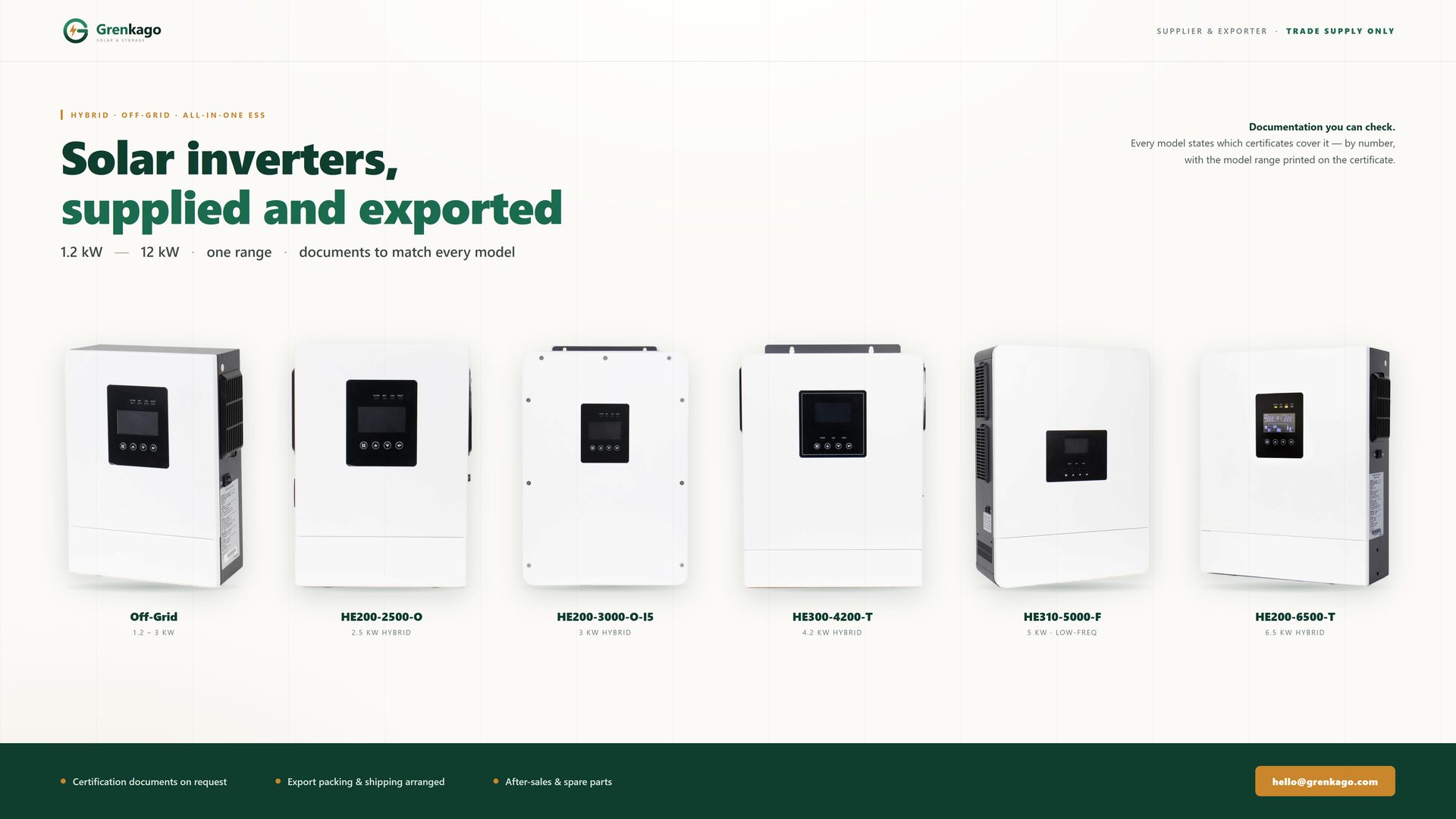
| Flat, essential loads | Lights, fans, TV, fridge, phone charging | 2–3.6 kW, 12–24 V | HE200-3000-O-I5 (2000 W, IP54) | start battery-free |
| Bungalow, pump + freezer | Above plus 1 HP pump | 5.5–6.2 kW, 24–48 V | HE200-6500-T (5500 W, 24 V) or HE200-7200-F (6200 W, 48 V) | 5 kWh class |
| Duplex, AC + borehole | Above plus air conditioning | 11–12 kW, 48 V | HE200-12000-F (12000 W, 2 × 7500 W PV) | 10 kWh class |
| Home + shop/clinic | Above plus business loads, maybe 3-phase | parallel from day one | HE300-7200-FP-I5 (IP54, 9-unit path) | 10–16 kWh |
For the battery side of that table, see our LiFePO4 vs lead-acid total cost comparison. Over a ten-year daily-cycle service the chemistry choice usually costs more than the inverter.
Brands commonly evaluated in Nigeria
Nigerian buyers typically shortlist from a familiar set of names (Luminous, Must Power, Felicity Solar, Deye and others), and the comparison is worth doing. What decides the outcome, though, is not the label on the box but five numbers on each specification sheet. Rather than rank brands, we set out the five checks and suggest running them against every shortlisted model:
| Check on the specification sheet | What to confirm |
|---|---|
| Continuous rated output | The wattage the unit actually holds, not the number printed in the model name |
| Battery voltage and BMS protocol | 48 V for a home above roughly 5 kW, and a protocol list that covers the battery you intend to buy |
| PV input and MPPT count | Total array watts accepted, and whether two trackers are provided for a roof with two orientations |
| Load-priority output | Whether critical and non-critical loads can be separated, so a water heater cannot empty the battery |
| Parallel capability | Whether the model parallels later, and up to how many units |
Two points about where we sit in that comparison:
- Grenkago is a China-based supplier and exporter, not a manufacturer. Our HE200/HE300 hybrid line runs 1.2–11 kW per unit, parallels up to 99 kW, operates without a battery, provides a dual load-priority output, and offers IP54 variants for outdoor mounting. Our BMS compatibility list covers Pylontech, Growatt, Deye, SRNE, Voltronic and others, and we confirm the pairing against your specific battery model before you order.
- We hold no ranking and make no claim about any other brand's performance, reliability, price or service, and we have not tested their equipment. Where this article states something about our own products, it is a specification we can document.
All brand names in this article are the trademarks of their respective owners. They are named either as part of the market a Nigerian buyer will encounter or as part of a battery protocol compatibility list. Nothing in this article endorses any brand, and nothing in it is a comparative or ranking claim about any brand. We have not tested other manufacturers' equipment. Specifications, product lines and availability change, so verify them against each manufacturer's current documentation before deciding.
Why sourcing from China works for this category
Nigeria already prefers Chinese brands for this segment (source: IndexBox, 2026), and the practical reason is the ecosystem: batteries, inverters, monitoring apps and spare parts in this market share communication protocols and mounting standards. A supplier sitting inside that ecosystem can match a 48 V pack to an inverter's BMS protocol list before shipment, quote IP54 variants for outdoor wall space, and consolidate the shipment, so compatibility questions are settled before the container ships rather than after it lands.
How to get a quotation
Send us five things and we return a sized proposal with model, battery and array plan:
- City (for sunlight and temperature assumptions)
- Load list: appliances, wattage, which must survive an outage
- Generator hours you want to eliminate
- Battery plan: start without storage, or the kWh you have in mind
- Any three-phase equipment on site
Write to hello@grenkago.com or use the contact page. A quotation request that carries the load list gets a sized answer, not a catalogue.
Frequently Asked Questions
What size hybrid inverter does a typical Nigerian home need?
Most homes running a fridge, lighting, fans, a TV and a water pump sit between 3.5 kW and 6.5 kW of rated output. A 6200 W unit covers that with surge headroom. Homes with air conditioning usually start at 11 kW or run two paralleled units.
Can a hybrid inverter run without batteries?
Yes. The HE200 and HE300 hybrid models run on PV and grid alone, which lowers the entry cost. A buyer can add a 48 V LiFePO4 pack later without replacing the inverter. Grenkago quotes this as a staged upgrade path.
Which battery voltage should an off-grid home use?
48 V above roughly 5 kW. It matches the 5–10 kWh wall-mount lithium packs this market prefers and keeps battery cable sizes sane. Remember the suffix: T = 24 V, F = 48 V, O = 12 V.
Will the inverter communicate with my lithium battery?
The BMS ports speak CAN and RS485 with protocols used by Pylontech, Growatt, Deye, SRNE and Voltronic packs. Send your battery model and Grenkago confirms the pairing before you order, and if direct communication fails, manual charge/discharge voltages are a documented fallback.
How many units can I parallel?
FP-suffix models parallel up to nine units: 58.5 kW on the HE200-7200-FP and 99 kW with a 415 Vac three-phase option on the HE300-12000-FP. Each unit keeps its own PV string.
Is outdoor installation possible?
Yes, on IP54 variants: the models with an I5 suffix use a sealed enclosure rated for outdoor installation. Note that IP54 models are separate SKUs: the rating does not carry over from the IP21 version of the same power class.
Conclusion
An off-grid inverter purchase in Nigeria is a ten-year decision made against a grid that may not improve and diesel prices that may not fall. Choose by rated output rather than the model number, lock the battery voltage at 48 V if storage is in the plan, size the PV input for daytime independence, demand the load-priority output, and buy onto a platform that parallels when the house grows. Grenkago supplies the HE200 and HE300 hybrid range across that whole path, from a 2 kW flat to a 99 kW three-phase site. See the hybrid inverter range or ask us for a sized proposal.