
Solar Backup for Commercial Sites & Workshops
One line: Commercial backup is a load-separation problem before it is a power problem. Decide which circuits must never stop, then scale the inverter to carry them.
Start with the load, not the inverter
A commercial site's total connected load is usually much larger than the load that must survive an outage. The first step is to sort the circuits:
| Category | Examples | Backup priority |
|---|---|---|
| Critical | Server rack, security system, lighting in occupied areas, refrigeration of stock | Must never stop |
| Essential | Office equipment, production machinery that cannot be interrupted mid-cycle | Should survive short outages |
| Non-essential | Air conditioning, water heating, vehicle chargers, decorative lighting | Can be dropped |
Totalling only the critical and essential circuits gives the backup load. This is usually a fraction of the site's supply capacity — and sizing to it rather than to the whole site is what makes the project economic.
Scaling options
| Backup load | Suggested configuration |
|---|---|
| Up to 6.2 kW | HE200-7200-F — single unit, 48 V, dual AC output |
| Up to 11 kW | HE300-12000-F — single unit, dual MPPT |
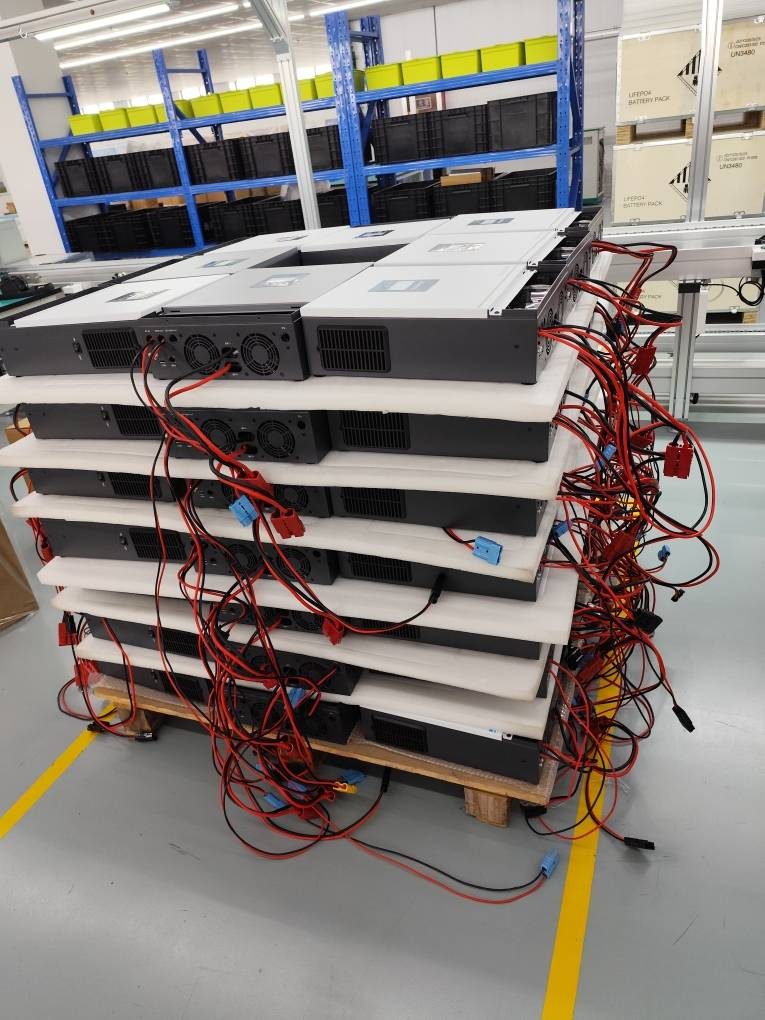
| 15–58.5 kW, single or three-phase | HE200-7200-FP — up to 9 units parallel |
| 20–99 kW, single or three-phase | HE300-12000-FP — up to 9 units parallel, 415 Vac three-phase |
Parallel units present to the site as a single supply — 240 Vac single-phase or 415 Vac three-phase. Each unit carries its own PV string, so a nine-unit system accepts up to nine independent strings.
Three-phase and generator auto-start
Two features decide most commercial projects:
Three-phase output. Sites with three-phase distribution — most industrial and larger commercial premises — need 415 Vac output. The FP models provide it directly, without a separate phase converter. Output current on the HE300-12000-FP is 450 A in parallel-expansion mode or 260 A in split-phase mode.
Generator auto-start. On the HE200-7200-FP the unit can start a connected standby generator automatically when battery charge falls low. For sites that already own a generator, this removes manual intervention and lets the solar system carry the base load while the generator covers peaks.
The critical-load separation logic
Dual AC output is not only a residential feature. On a commercial site the same logic applies at the circuit level:
- Main output — server room, security, cold storage, essential lighting.
- Secondary output — general office power, air conditioning, non-essential machinery.
When battery charge runs low, the unit drops the secondary output and keeps the main output running. Nothing is lost that matters; the non-essential circuits resume when charge recovers or the generator starts.
Sizing to a 6200 W model with load separation often achieves what a 15 kW system would without it — because the load management removes the need for the extra capacity.
Sizing the battery on a parallel system
This is where parallel projects go wrong most often.
Nine units multiplied by a 150 A charge ceiling is a very large combined current. If the system commands that current into an undersized battery bank, the battery is destroyed quickly — and the cause is not obvious, because the inverter is behaving as configured.
The rule:
- Lead-acid: combined charge current no more than 0.2C.
- Lithium: combined charge current no more than 0.5C.
A 48 V 500 Ah lithium bank, for example, permits 250 A at 0.5C. Nine units must therefore be configured so their combined charge current stays at or below 250 A — which means either a larger bank or a lower charge-current setting per unit.
Size the battery for the intended autonomy as well:
Usable battery (kWh) = daily critical load (kWh) × autonomy (days) ÷ depth of dischargefor the critical load only, not the whole site.
PV and output capacity
Each string accepts up to 7500 W on the HE300-12000-FP, within a working voltage range of 90–450 Vdc and a maximum open-circuit voltage of 500 Vdc. A nine-unit system therefore accepts up to 67.5 kW of PV while providing up to 99 kW of output — the array covers base load and battery charging, while the battery and generator cover peaks.
Certification note
The HE300-12000-FP holds CE EMC certification (CKEYS251201016) and GB 4943.1-2022 safety coverage (BDL260706S002) — the latter as a series model under the report whose main test article is HE300-12000-F. That safety report is usable evidence in tenders and supply-chain due diligence for the HE300 mid-power range. No FCC or RoHS file is held for this model.
Full detail, including what is not held, is on the certifications page.